Theatreship: a brief history - A brief history of the construction of Theatreship (built 1913) and her old working life.
The ship that would become Theatreship is a Klipperaak of riveted steel construction. It was built in 1913 by Van der Adel.
Klipperaak: Klipperaaks were a turn of the 20th century innovation, a portmanteau of Klipper (clipper) and aak (barge), they married the swept pointed bows of the cargo clippers (like the Cutty Sark winning speed records on the transatlantic trade) with the cargo capacity and shallow draft of the the traditional dutch Tjalks. They're basically the mullet of cargo ships - speed in the front, cargo in the back.
Rigging: Theatreship was originally rigged as a gaff cutter. A gaff rig has a spar at the top of the sail - meaning the sail has four corners (compared to a three corner sale on a mdoern triangular 'sloop' rig). This means the sail is more square. For a given sail area, making the sail more square increases the sail area low down, which provides more power to the ship, while reducing the pivoting force trying to capsize you. It also means you can get away with a shorter mast for the same sail area. The presence of the gaff spar also gives you fine tuned control over the shape of the sail - by increasing the angle of this spar you can pull the sail tight and flat, allowing you to point closer upwind, decreasing the angle lets the sail relax, filling out a more rounded shape with a deeper belly, giving you more power off the wind. You also have an emergency option, letting go of the peak halyard completely! If you're heeling over too much, dropping this line drops almost all the tension in the mainsail, 'scandalising' the main, this quickly depowers the sail, preventing a capsize. A cutter rig just means that there's two foresails.
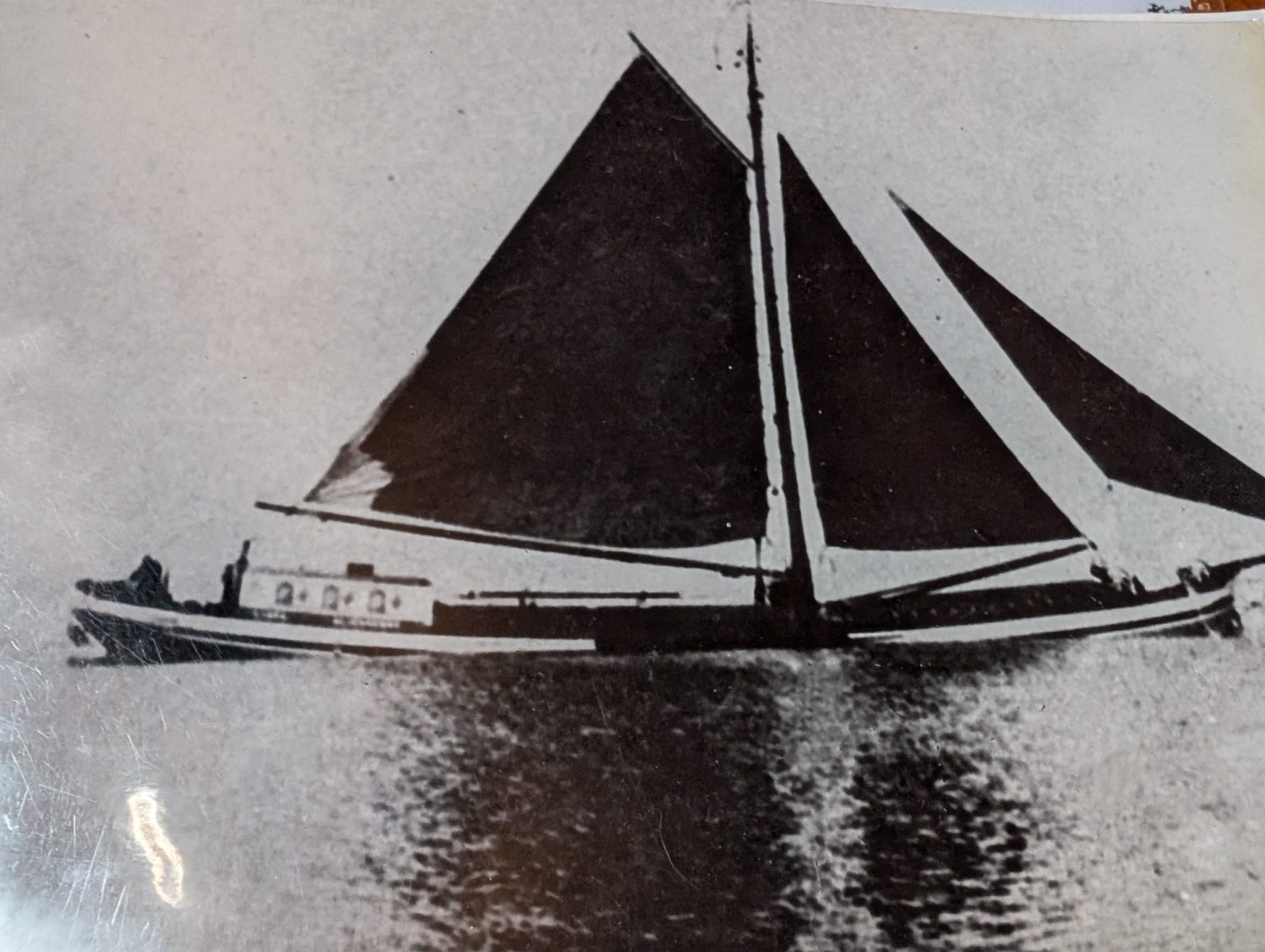
You can see in this picture of her under sail the gaff mainsail (with the boom at the bottom of the sail and the gaff spar at the top of the sail). She's flying two foresails: a boomed staysail just in front of the mast, and a jib at the very front, flying from the bowsprit. The boomed staysail made the boat very easy for a short-handed crew to handle. It's basically self tacking - turning through the wind, the boom would follow the the sail to naturally move the clew over to the correct side. The bowsprit extended the sail length of the boat, allowing a greater sail area. In short the combination of the gaff rig with the bowsprit means Theatreship was flying the sails of a much larger boat. She was a speed machine!
Construction: The ship was built originally of riveted steel. The process was incredibly labour-intensive. Tens of thousands of holes were punched and reamed, and hot rivets were hammered in to join the plates together. Each rivet required a five-person team to fit: a 'heater' warmed the rivets in a portable forge, a 'catcher' grabbed the hot rivet and pushed it into the hole, and a 'holder-up' pressed a heavy bucking bar against the back of the inserted rivet. Finally, two riveters would pound the glowing metal tight - one holding a domed tool called a 'snap' over the protruding end, while the other struck it with a massive sledgehammer to form the distinctive round head.
A good team could fit around 200 rivets a day. Theatreship's construction involved over 50,000 rivets. It would have taken over 200 days of solid labour just for the riveting. These ships were truly labours of love. The side effect of this labour intensity was that a huge amount of attention was paid to beauty. The amount of time it took to make any ship meant that aesthetic decisions which would be costed out of contemporary designs as too expensive represented only a marginal increase in time. The ships ended up with beautiful graceful curves. I guess if you're spending 200 days making something, you really want that thing to be beautiful.
Riveting was an astonishing process - as the hot rivets cooled, they shrank, this contraction put an incredible clamping force on the joint. The ship uses 3/4" shank rivets. Each rivet exerts approximately 4.2 tonnes of clamping force. The two sheets of steel are pressed together so tightly that the joint is entirely waterproof. This clamping presssure means the joints are constantly under tension, and it creates an incredibly strong, vibration and flexion resistant joint. There's a reason why Theatreship has survived in operating condition for 113 years.